EARTHQUEST (Canada) for the Environment

Learn how to be a field biologist, Biology, research and conservation, Field training and employment opportunities


Applications now being accepted for ELC certification course scheduled for May, 2012. Please contact us for details & a registration package!navbar

Testimonials

Frequently Asked Questions

History

International FBT Courses

FBT Aquatic/wetland plant courses

Environmental consulting services

Environmental consulting course

FBT Bird courses

FBT terrestrial plant courses

International FBT Program

GIS certification course

Internship program & opportunities

Primate FBT Courses

Medicinal plant FBT Courses

FAT Courses in management/leadership

Nicaragua Ecology and Behaviour of primates courses

Costa Rica Ecology and Behaviour of primates courses

Rainforest Ecology course

International Ethnobotany course

Application form for all programs

Reference form and letter for all programs

Biological Field School

Biological Field School application form

Reference form and letter for Biological Field School

Workshops

Jobs

Financial aid

GIS course

Environmental assessment course


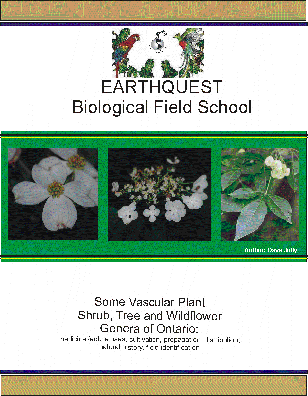
Now available; a new Tree and Shrub book authored by the Senior Instructor of the EARTHQUEST Biological Field School - Dave Jolly
Scientists, herbalists, green house workers, habitat restoration ecologists, teachers, naturalists, botanists and people considering internships and jobs with EARTHQUEST or work in the environmental industry are strongly urged to purchase this book for only $200.00 CND + shipping and handling
To order please contact us for more details


Photos: Dave Jolly


International Field Biology Training (FBT) Program
Courses

Our classes are small so that the instructor may direct their attention to students 1 - 1. The International FBT program is divided into multiple courses to help people upgrade their skills in order to qualify for employment in the environmental industry. Students may concentrate on plant courses, bird courses, or combine courses to provide a broader prospective. Our courses do provide an in depth examination of how to visually field identify common vascular plant families and genera and we do spend more time investigating how to perform flora and fauna (for example, amphibian) surveys. Graduates of our course should leave with a good basic knowledge of flora identification skills, particularly where to look for Ontario Species at risk (SARs) and how to assess them.

In order to qualify for internships through the Biological Field School and become full time students must enroll in a minimum of 3 courses. Students who simply enroll in 1 course will not be considered. This will allow an instructor to work with you to improve your resume, cover letter, provide job finding strategies. It also places you on the list to receive weekly job postings so that you may start applying to suitable jobs immediately. Please choose from the following list of courses. If you wish to discuss courses with an instructor please contact us;

Core International FBT Program courses
Plant courses
Bird courses
Management courses


Principles and concepts of Ecological Land Classification - $1550.00 CAD

This course is recognized by a number of employers in the environmental industry. Employers who have sent their staff to participate or are considering it include;

i. Hullet Provincial Wildlife Area, Clinton, Ontario
ii. Watershed Management Ecology (environmental consultants), Mississauga, Ontario
iii. Avalon Environmental Consultants, Fort Erie, Ontario
iv. Bruce Power

The following employers have hired graduates who have taken this course;

i. Upper Thames River Conservation Authority
ii. Credit Valley Conservation Authority
iii. St. Clair Region Conservation Authority
iv. Halton Conservation Authority
v. Grand River Conservation Authority
vi. Bird Studies Canada
vii. Point Pelee National Park
viii. GMS Ecological and Forestry Services, Inc
ix. Catfish Creek Conservation Authority
x. O'Connor & Associates environmental consulting
xi. Bruce Trail Conservancy
xii. Thunder House forestry services
xiii. Wildlife Preservation Canada
xiv. Volunteers for Peace
xv. Bruce Power
xvi. Alberta Biodiversity Monitoring Institute
xvii. M.K. Ince and Associates
xviii. Canadian Wildlife Service

Here's what professionals have to say about our courses;

"In my experience, graduates from Earthquest Canada are well qualified to participate in consulting practices and the market is currently in short supply of well-qualified individuals. I am most familiar with wetland delineation, Ecological Land Classification, and bird identification coursework put forth by Earthquest. I have sent some of my professional biologist staff for coursework at Earthquest and was very happy with the improvement of the professional skills of program participants."

Avalon Consulting Professionals
P. Leigh Whyte, MCIP, RPP, AICP
Principal/Chief Urban Planner

This course focuses on combining the concepts of hydrology, soil science, forestry, geology and biotic factors to classify natural areas. Students will spend 20 - 30 hours learning how to identify soil types, how water flows, applying plant field ID skills and recognising vegetation communities. The course will utilize soil labs and field practicums to reinforce concepts learned. The culmination will be a student project on classifying a natural area. This project will be submitted in written and oral format.


Unit #1: Principles and concepts of Ecological Land Classification (ELC)

A review of how ELC was developed for field practioners in Ontario and it's application for municipal regulations and laws.


Unit #2: Soil Science

We will learn how to identify and classify soil types into drainage and moisture regimes.


Unit #3: Plant communities and classification

An examination of some of the common vegetation communities encountered in southern Ontario. Students do spend a considerable amount of time learning how to field identify vegetation in all layers.


Unit #4: Polygon Description and Classification

Polygon delineation, description and classification is emphasized by amalgating all data collected from field practicums. The requirement to pass this course is to perform ELC work on your own polygon.
The prerequisite for this course are the Level 1 and 2 General Terrestrial and Aquatic/Wetland FBT plant certification courses. A typical schedule in this course might resemble the schedule below;


General Schedule of Activities

Day Morning Afternoon
Day 1 Fundamentals of conducting an ELC History of ELC
Day 2 Soil science Soil lab to determine soil types
Day 3 Field Studies Field practicum; dig soil pits and analyze soils
Day 4 Field Studies Delineating polygon boundaries
Day 5 Field Studies Walk polygon to identify plants
Day 6 Field Studies Perform tree tally work
Day 7 Field Studies Collection of data
Day 8 Field Studies Collection of data
Day 9-12 Field Studies Write-up reports
Day 13 In class preparation Presentation of report

In 2012 the ELC certification course will be offered on the following date;

Book early to avoid disappointment as this course fills quickly and most people reserve at least one year in advance. If you book before April 15, 2012 you'll receive a $50.00 discount if you state that you saw it on our website.

Registration deadline 12 Noon April 15, 2012

Two day version: May 12 & 13, 2012

Cost

$1410.00 CAD + $40.00 (ELC field manual) + $100.00 (Plant Genera of Ontario) = $1550.00 + tax = $1751.50 CAD Total

This course is provincial, national and international in focus, meaning it incorporates principles applied in the USA as well as Canada and focuses heavily on plant field ID and mapping.


Under the guidelines of the Renewable Energy Act, we now recommend practioners to obtain their wetland evaluation certification from the MNR sanctioned course. Please contact the Brian Potter at the MNR for details.

The principles and concepts of ELC courses must be taken by attending field sessions at our Biological Field School for 2 days. Only a limited number of spaces are available to participate in 2 day field practicums, so it is strongly recommended that you reserve your spot before somebody else grabs it! Generally, 2 day field practicums run over a weekend on a Saturday and Sunday. Please email to inquire about availability of spots in this course. Due to the popularity of the ELC certification course we can only accept applications on a first come, first pay basis and we cannot reserve spaces or place your name on the waiting list until full payment is received.

To learn more about the Bruce Trail Project mini course please consult;

Bruce Trail Project mini course

Once you have completed your training talk to us about helping you find employment.

Benefits of training

You can contribute to any ELC work needed by employers, municipalities, environmental consulting firms, etc.
Participants of the Niagara Escarpment World Biosphere Reserve Bruce Trail projects may contribute directly to ongoing research for the Bruce Trail Project.

Practical hands-on field experience.

Increase the amount you can be paid in the environmental field significantly since very few enviro job applicants possess ELC certification and are hard to find by employers!

*Note*: Our ELC course provide similar provincial content to the MNR version, but is not to be misconstrued, interpreted or confused with the MNR version as it is also nationally and internationally focused. We focus more heavily on vegetation and mapping. All EARTHQUEST courses and programs are subject to change.


Purchase your copy of our new book on the flora and fauna of the Niagara Escarpment World Biosphere Reserve
$27.50 CAD + shipping and handling
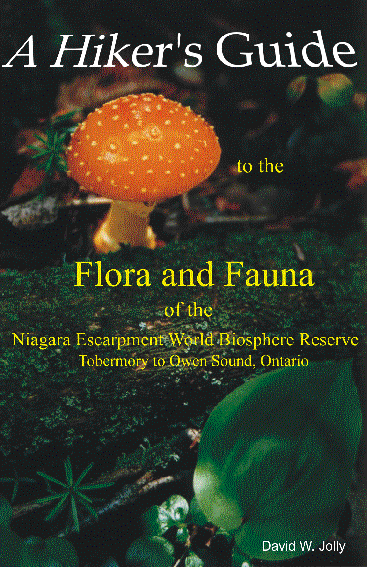
Photo: Dave Jolly
for more information please click on;

Bruce book


Learn how to be a field biologist, Biology, research and conservation, Field training and employment opportunities

 E-mail: earthquestcanada@yahoo.com

Senior Instructor/Biologist/Consultant
D. Jolly, B.Sc.
EARTHQUEST (Canada) for the Environment

Tel: Please email for an appointment
©copyright EARTHQUEST (Canada) for the Environment

Website designed and maintained by D. Jolly
Last Updated 1/1/2012